
10/08/2026
Antarctica: A natural CO₂ sink in the deep waters of the Ross Sea
The darkness of the deep sea is not an inert environment: a study led by OGS and the Institute for Biological Resources and Marine Biotechnologies of the National Research Council (Cnr-Irbim) has revealed for the first time that microorganisms living in the deep waters of the Ross Sea, Antarctica, play an active role in the fixation of dissolved inorganic carbon (DIC) even in total darkness. This process has not been accounted for in oceanic carbon budgets until now, with potentially significant implications for understanding the global carbon cycle.
The research, published in the journal Communications Earth & Environment, was coordinated by Mauro Celussi from OGS with contributions from Gian Marco Luna, Marco Basili, and Grazia Marina Quero for Cnr-Irbim. The work is based on incubation experiments conducted on water samples collected between 200 and 2,000 meters depth during two oceanographic campaigns aboard the research vessel R/V Italica, as part of the PNRA DEEPROSSS project.
The results show that dissolved inorganic carbon (DIC) fixation occurs at rates comparable to those measured in the world's major ocean regions, despite the extremely low temperatures. Projecting these values across the entire volume of water masses in the Ross Sea, the team estimated that the carbon fixed in the dark depths is equivalent to about 5% of this sea's annual CO₂, a contribution that is far from negligible and, until now, omitted from carbon cycle models.
Sampling was carried out during the XXIX and XXXI Italian Antarctic Expeditions aboard the R/V Italica in early 2014 and 2016. The research was conducted within the framework of the National Antarctic Research Program (PNRA), funded by the Ministry of University and Research (MUR) and implemented by the National Research Council (CNR) for scientific coordination and by ENEA for logistical planning and organization. Operations were coordinated by the National Institute of Oceanography and Applied Geophysics - OGS, which since 2022 has served as the PNRA implementing body responsible for the technical and scientific management of the research vessel Laura Bassi.
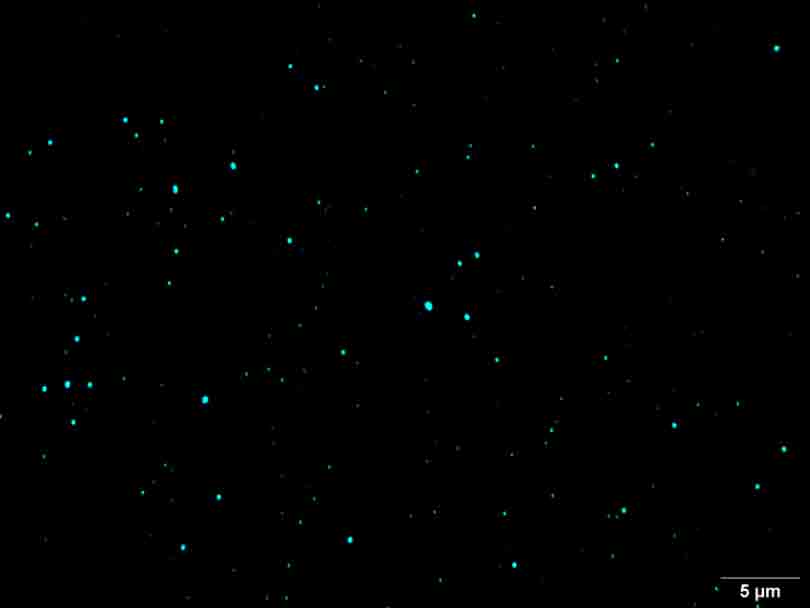
Photo: Deep-sea microorganisms (bacteria and archaea) under a confocal microscope (μm stands for micron; 1 μm corresponds to one thousandth of a millimeter). Credit: N. Tomasi
View also