23/01/2026
Extratropical cyclones can influence CO₂ uptake in the Mediterranean Sea
The CO₂ balance of the Mediterranean Sea may also depend on the action of storms crossing the region, more specifically on the influence of extratropical cyclones—meteorological systems associated with cloud cover, rainfall, wind, and thus unsettled weather. A new study by the National Institute of Oceanography and Applied Geophysics (OGS), recently published in the Journal of Geophysical Research: Atmospheres, has highlighted a relationship between periods of enhanced CO₂ uptake by the Mediterranean Sea and atmospheric circulation at the regional scale (i.e., on the order of hundreds to thousands of kilometers).
The research team from the OGS Oceanography Section analyzed several oceanographic and atmospheric datasets covering the period 1999–2020. In particular, they found that events of strong CO₂ uptake in the Mediterranean Sea during winter occur in the presence of specific regional-scale atmospheric configurations. These configurations are responsible for more intense wind regimes and lower-than-average temperatures—conditions that affect air–sea exchanges.
Following evidence of the link between uptake events and the passage of cyclones, the research group also estimated the probability of finding one of these atmospheric systems near the areas affected by strong uptake events. The analysis shows that this probability increases with the intensity of the event itself. In most cases, these storms develop within the Mediterranean basin and are larger in size, associated with more pronounced low-pressure systems and characterized by more intense circulation than those that typically cross the region.
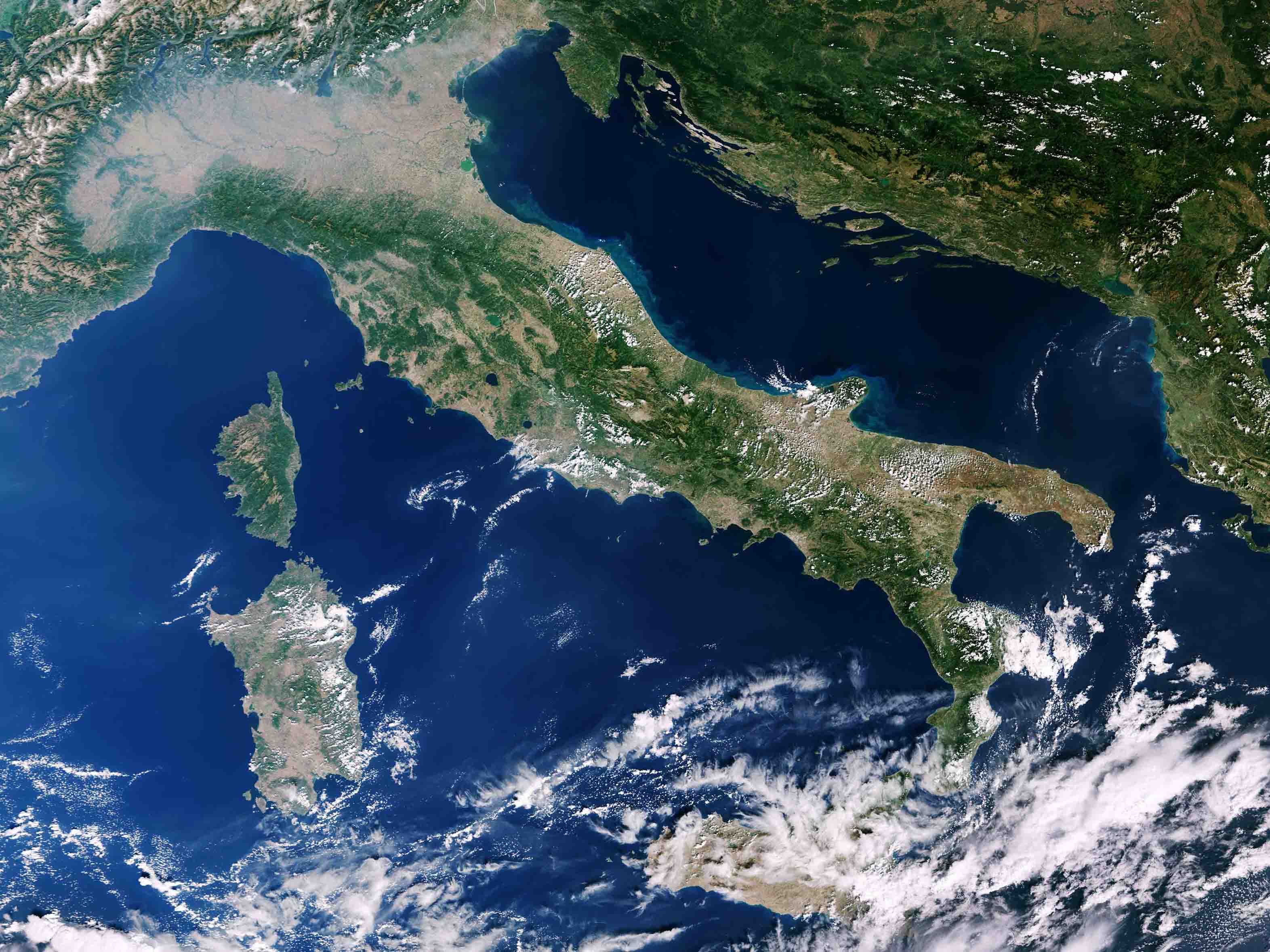
Image credit: ESA
Info