
11/11/2026
Three powerful earthquakes in the Drake Passage in 2025: two new studies reveal their mechanisms and origins
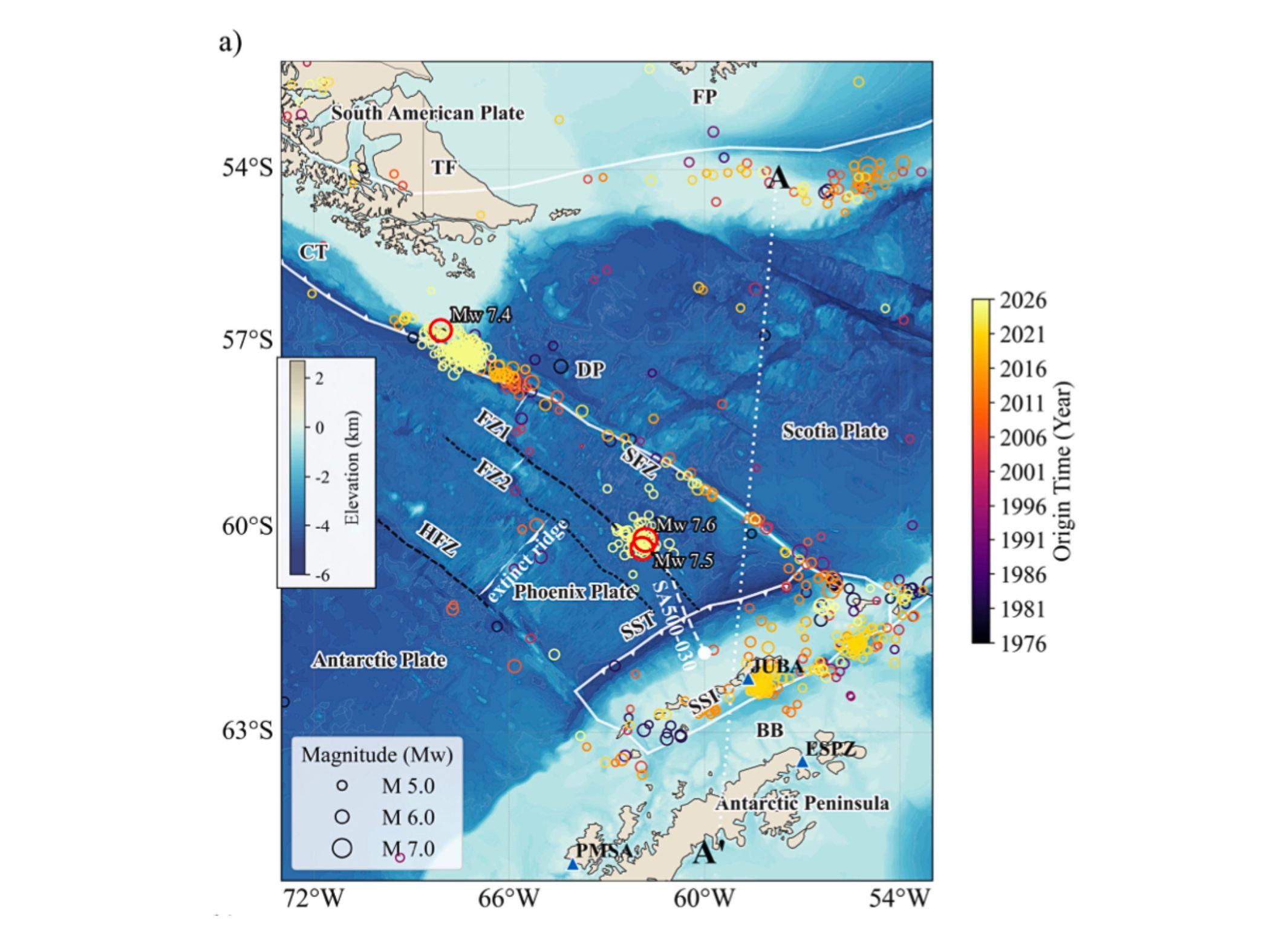
In 2025, the Drake Passage, the body of water separating Tierra del Fuego from the Antarctic Peninsula, was struck by three earthquakes with magnitudes greater than 7.4. This was an exceptional event for a region characterised by tectonic plate movements of just a few millimetres per year.
Two new studies, coordinated by a group of researchers from OGS, in collaboration with CNR-ISMAR, the University of Urbino Carlo Bo, Argentina's CONICET and the University of Buenos Aires, shed light on the causes and dynamics of this unusual seismic sequence.
The first of the two studies, published in the journal Geophysical Research Letters, focuses on the magnitude 7.4 moment magnitude (Mw) earthquake of 2 May 2025, the most powerful ever recorded at the transition between the Chilean trench and the Shackleton Fracture Zone. Utilising state-of-the-art artificial intelligence techniques and advanced methods, researchers were able to meticulously reconstruct the earthquake's dynamics, successfully identifying seismic wave phases sensitive to depth. This comprehensive analysis enabled the precise determination of the rupture's origin, located approximately 25 kilometres beneath the seafloor. The analyses also revealed a particularly complex rupture process involving several fault segments in an area where a convergent plate boundary meets a strike-slip plate boundary.
The second study, published in Communications Earth & Environment, focuses on two strike-slip earthquakes (earthquakes generated by the horizontal sliding of two blocks of oceanic crust past one another along a sub-vertical fault plane) with moment magnitudes of Mw 7.5 (22 August) and Mw 7.6 (10 October), respectively. These events occurred approximately 15 kilometres apart within the Phoenix oceanic plate, which is considered to have been tectonically extinct for around 3.5 million years. The research team also identified approximately 200 additional seismic events, thereby reconstructing a sequence characterised by two major earthquakes, both with rupture lengths well in excess of 100 kilometres. The analyses therefore indicate that the 2025 seismic sequence reactivated ancient oceanic strike-slip faults.
These structures, which accommodate the horizontal deformation of oceanic ridges, are considered tectonically inactive once the relative movement of the plates along them has ceased. The two major earthquakes recorded demonstrate that ancient fracture zones can remain mechanically active, even long after they have ceased to function as boundaries between tectonic plates. The study also highlights the upward migration of magma along the fault on which the two earthquakes occurred.
The investigated dynamics are therefore of significant importance for defining the geodynamics of tectonic plates and understanding the mechanical evolution of the oceanic lithosphere. This is particularly relevant for the global interpretation of intraplate seismicity.
View also